Thursday, April 16, 2009

Swallowing Darkness by Laurell K. Hamilton

I thought I'd take some time out from all the YA reading I've been doing and check in with the Meredith Gentry series.  This is the seventh, and I've read the previous six (which surprises me; I didn't think there'd been that many). 

I think I like this series better than the Anita Blake series, or at least better than what the Anita Blake series has become.  There is a lot (A LOT) of sex and violence in this series as well, but the sex seems less pointless.  Meredith is part human and part fairy, descended from a fertility goddess. So, basically, she is bringing the magic back to fairy through sex.  There are things I like and things that bug me about this book, but overall it was fun.

I like most of the characters in the book, and I do like seeing what magical power Merry and her men are going to awaken next.  Also I am a total and complete sucker for the Wild Hunt, which plays a big role in this book, so I was sold there.  (I've been enamored of the Wild Hunt since I read and reread The Dark Is Rising as a child.  Look for it to appear in my own writing.)  I thought the Hunt scenes were intriguing and very well done.  In fact, the research on the entire fairy aspect appears thorough.  I'm by no means an expert, but the few things I know are authentically represented in this series.  Finally, despite the fact that the Anita Blake series has degenerated into almost entirely pointless porn, there is one thing both Merry and Anita have in common.  They are so very much not rescue bait.  If there is something difficult that must be done (killing, dismembering, whatever), they saddle up and get it done.

That said, there are a few nagging points.  First, I repeatedly get the sense, both in the Anita Blake series and in this one, that Laurell K. Hamilton is not big on mapping out everything ahead of time.  (I could be wrong, in which case I deeply apologize.)  However, it seems like every time a protagonist is in a tight spot, the solution is, "Hey, what if she develops this magical/sex-related ability?"  Or . . . what if the goddess gives her (or someone, um, "near" her) a new magical/sex-related ability?  As much as I like the fact that the goddess goes to bat for Merry, it seems a little too deus ex machina a little too often. Finally, Merry has been whining for six books now (six, really?) about how her poor little mortal self is so fragile and killable. But she's got the Hand of Blood, and the Hand of Flesh, and the goddess on her side.  And now she has an additional important artifact.  Plus, she's surrounded by all the best fairy fighters, many of whom are getting their god-like powers back.  And, apparently, no matter how magical or immortal, the fairies can all be killed by bullets.  Let's stop the whining, shall we?

Still, that said: fun read.  (Rated X: sex, gore . . . but, really, less than usual)

Tuesday, March 24, 2009

Summer Reading

It's March; that means it's time to pick out middle school summer reading.  So I'm doing two things, searching for the one required summer reading book for rising seventh graders, and reading two selections from the Virginia Readers' Choice 2009-2010 list.  We (the language arts teachers) are hoping to simplify our lives this year by being able to say, "Read this one required book and then choose one other book from this great list."
I started off looking for a required book that had something to do with myths, since that's our first, short unit in the fall.  It had to be as good as Percy Jackson, but not Percy Jackson, since our elementary teachers have now stolen that book from us and are reading it at the 4th and 5th grade level.  (For those uninitiated who haven't read previous posts, start with The Lightning Thief by Rick Riordan.)  So, I Googled "if you liked Percy Jackson," and I came up with some interesting choices, one of which was Goddess of Yesterday by Caroline B. Cooney.

I had read and enjoyed Ransom of Mercy Carter and know many students who have read and enjoyed The Face on the Milk Carton by the same author, so I had high hopes.  Of course, the book was originally published in 2002, which is practically ancient to a middle schooler (almost two thirds of their life ago!), but on the plus side that means it's out in paperback.

The book is about the adventures of Anaxandra, a girl who is taken hostage from her tiny Mediterranean island home early in the book and continues through a variety of adventures that end up involving Menelaus, Helen, Paris, and the city of Troy.  It's well-written and has enough excitement, intrigue and battles to soothe the injured sensibilities of boys required to read a book with a female protagonist.  Meanwhile, the strong, self-sufficient heroine is bound to appeal to the girls.  (No rescue bait, here, thank you very much!)  In all, I thought it was excellent.  I wish there were a sequel instead of the author's note at the end.  It's a strong contender for the "required" book, but I haven't 100% made up my mind.  It's such a lot of pressure to be asked to choose the book people are required to read.  And, sadly, the cover flap gives away over half of the book.  

(PG-13 for some of those battle scenes, and some hinted at adult situations that don't happen at all or don't happen "on screen.")


London Calling by Edward Bloor is off the Virginia Readers' Choice list, and I'm so glad that I got to read it!  I chose it as one of the two books I'm previewing because, from the blurb I read about it, it seemed to have some fantasy elements (I'm "the one who likes fantasy" on our team).  Also, I really enjoyed Bloor's Tangerine, which has been on the sixth grade summer
 reading list for several summers, usually garnering enthusiastic responses.  

Anyway, other than being well-written, engaging, and authentic, London Calling is completely different.  It's about a seventh grade boy who is aimlessly sleeping his life away, living a solitary existence in his basement, and really at loose ends.  Despite how it sounds, he's not whiny or self-pitying, and it's easy to like him and identify with his fears and foibles.  Martin inherits a mysterious radio from his grandmother that seems to allow him to travel back in time (in very vivid, realistic scenes) to WWII.  Or is he dreaming?  And if he's dreaming, why is he dreaming about things he himself has never heard of ?   This book has a strong (but not at all preachy) religious element to it that I thought worked beautifully within the story.  I also particularly appreciated the supporting cast, since so many YA books have the main character acting alone against the world.  It was interesting to see who Martin chose to tell his secrets to, and how that worked out for him.  I'm not really doing it justice here because I don't want to give away any of the mystery or angst or the well-drawn, annoying, heart-breaking, and uplifting relationships between the characters, but I highly recommend this book.  There are so many different levels to appreciate.


(PG-13 . . . or PG-12 since it's on the middle school list.  Some adult situations and battle scenes.)

Sunday, March 8, 2009

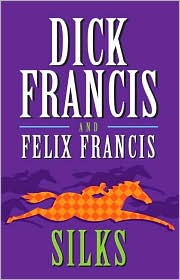
Silks by Dick Francis and Felix Francis

So here's the danger of allowing me to browse the "New Fiction" section in my local library.  I end up ignoring my work, the beautiful weather, a perfectly decent literary novel loaned to me by a coworker, the laundry, the insidious layer of god-knows-what creeping through my house and taking over every horizontal surface (papers? Legos? junk mail?), and I spend the weekend reading Dick Francis.

I love Dick Francis books.  I've loved them since I was in high school and my dad got me started on them.  (My dad, by the way, has read everything.)  They're very similar to each other, so it's difficult to remember the plots, though they all have something that stands out. My dad and I will discuss them as, "The one that started with the guy standing in the fountain," or "The one that ended with the main character chained to the steering wheel."  It's always interesting to me to see what exactly my brain chooses to remember from books I've read.  But that's another blog entirely.

A very smart and savvy author, Dianne Mott Davidson, who was here last year for the James River Writers conference, told me that Dick Francis did not actually write his books, that his wife did.  From what little I've read, it's true (or they, at the very least, collaborated), so it would make sense then that, since his wife's death, he is now writing with his son Felix.  I was interested to see if I could tell a difference. The last Dick Francis I read was Under Orders, a Sid Halley book I was disappointed in.  I loved the first three Sid Halley books, but the fourth just wasn't as good.  Maybe it needed help it didn't get from Mary Francis.

Anyway, on to Silks.  It was pretty good.  Good enough to devour in a 36 hour period, anyway. The main character is a barrister (British lawyer), and it was somewhat interesting to see the workings of the British legal system, though they were, I thought, over-explained. (Perhaps that was Felix?)  I was much more interested in the part about why race horses get nose bleeds and how their lungs work, but maybe that's what's left of my horse-crazy younger years showing.  

The characters were reasonably compelling and engaging.  The pace moved along well (except the over-explained law bits).  No one really did anything out of character or especially stupid.  Good, quick Dick Francis read.  And Felix.  Maybe it will be "the one with the guy with the baseball bat."

(Rated R: violence, language, sex)

Monday, August 11, 2008

Robert B. Parker Overload!


So . . . I also caught up with the books I hadn't read in the Sunny Randall series.  I like Sunny, sort of reluctantly, so I was happy to find there were four I hadn't read. On Robert B. Parker's website, it says he wrote the series so Helen Hunt would have a Parker movie role.  Really Sunny's just a female Spenser.  They talk and think alike, so the books really aren't noticeably different from the Spenser books.  Except for no Hawk, which is a definite negative.  She has Spike, though, and Spike's wonderful.  And Rosie instead of Pearl for us dog lovers.

I can't quite get my head around Shrink Rap.  The actual book didn't seem familiar, but the plot was so deja vu that I couldn't help wondering if I'd read the book before.  It almost seems like Parker might have used this same plot (woman has to go undercover to trap a psychiatrist who is victimizing women) in a Spenser novel.  Usually I remember actual scenes or phrases from books I've already read, and this didn't ring any of those bells.  Still . . . this plot . . . I've been there before.

Melancholoy Baby was my least favorite of the remaining three because you know who the "who" in "who dunit" is long before the end.  The "mystery" you're left with is "How will they prove it?"  Which isn't that interesting.

The best part about Blue Screen was that it combined Sunny and another Parker character, Jesse Stone.  Sunny and Jesse seem made for each other because they're both having problems moving on to a new relationship because they're so stuck on their exes.  There's some great chemistry there.  

However, I'm guessing some fans (or maybe Parker himself) had major objections, because by the time Spare Change opens, their relationship hasn't worked out.  It could just be because I read four in a row, but the whole angst-driven thing about the Sunny/Richie "relationship" is starting to get on my nerves.  (I'm not much on extracurricular angst, being a middle school teacher.)  Another thing that bothered me was that in Blue Screen Richie had remarried and was having a son.  But in Spare Change Richie is thinking about divorce and no child is mentioned.  What the heck happened to the kid?  Angst aside, the main plot of the book was engaging enough, and it would probably be a tie between Spare Change and Blue Screen for which of the four I liked best.
(R: sex, violence, language)

Catching up with Robert B. Parker


It had been awhile since I'd read a Parker book, and I realized with greedy joy that I had quite the selection to choose from.  Thankfully, even with two junior book lovers at home, my library card was not quite maxed out, so I checked out a bunch.  

I read Widow's Walk first, and it wasn't that great.  It served to remind me of all the things I like about Parker and his main character, tough-guy private detective Spenser.  But the client Spenser is working for is incredibly shallow and stupid (and she's supposed to be).  It's more fun to hang out with Spenser when he's hanging out with people who are worth your while.

I loved Cold Service because it had lots of Hawk in it, and who doesn't love Hawk? Sadly, because all Spenser books are first person point of view, from Spenser's pov, we don't really get to see what happens at the end.  You could claim that just makes it even more mysterious and Hawk-like.  But it's still disappointing.  

School Days I had actually read before and remembered almost immediately upon opening it. So I just breezed through it.  Which is quite the speed read for a Parker book.  Since he does a great job with dialogue and plays to his strengths, some pages have almost no words on them.  I personally think there's a bit of cheating involved when he starts a new line and the same person is still speaking, but it's (again) a picky English-major point.

Hundred Dollar Baby brought back the character of April.  I only dimly remember who April is, and the book was all right, but I wasn't too sympathetic toward her.  Let me just repeat that I like Spenser better when I care about the people he's working for.  

Now and Then had Hawk, and Vinnie, and Teddy.  Tough guy bliss.  I enjoyed it.  But somewhere around here, I started to realize why it might not be a good idea to read so much Robert B. Parker at one time.  It didn't stop me though . . .
 
(R: language, violence, sex)

Saturday, June 28, 2008

I'm Obsessed! Naomi Novik and the Temeraire Books!


I'm not sure where I heard about these books--possibly on the Creatures 'n Crooks website, since they're having Naomi Novik in for a visit in July.  (I can't wait!)  Anyway, there are actually four books currently, but I didn't have room for all of the graphics.  The fifth book is coming out in July.

I was blown away by His Majesty's Dragon.  I think it's the best dragon series since Pern (and yes, my middle school friends, I have read Eragon).  She even has a quote from Anne McCaffrey on the front of the third one--don't know if you can see that in the graphic.  In fact, it's a lot like Pern with the dragon riders, and the egg hatchings, and the relationship between dragon and rider.  However, it's historical fantasy fiction, and it's set in the time of the Napoleonic wars, with dragons used on both sides in the war.  I thought that was a tremendously clever idea, and even though I'm embarrassed to admit that I don't remember much from that era of history (Waterloo and Lord Nelson, and that's about it), I'm finding it incredibly engaging.    

I think I read the first three in a week, and now I'm trying to ration the fourth one for myself.  I have all this homework to do for a teaching class I'm taking, and once I start reading, I know the homework, the housework, and the caring-for-the-children work is going to go straight out the window.  (Sure, you can play Nintendo!)  So I'm speaking to myself very sternly about it. I'm having a hard time, though, because the books always have an excerpt of the next book at the end, and something completely and thoroughly horrible is happening in book four.  I want so desperately for everything to be all right that I want to just get there right now.

I really like it when I discover a series that has a bunch of books already published so that I can read merrily along without waiting for the next one.  I tend to devour quickly, which is bad for long term memory of the finer points.  (Thank goodnes J. K. Rowling is queen of the catch-up clues!)  The bad thing is, of course, that then it's over so quickly.  Plus I also don't end up spending a lot of time reflecting on the books, which I'm forced to do while waiting for new ones.  Still, I have done some reflecting on these, simply because I like them so much.

So far, the second one is my least favorite.  (Funny, the second Harry Potter and the second Lord of the Rings are my least favorites, too.)  The main reason I like it less is because I thought the climax was unsatisfactory.  After a great deal of thinking about it, I decided it was the most logical climax to have, but it was over in barely a sentence.  You blink, you miss it. That made me irritated because there was A LOT of build up.  Plus Temeraire spent a great deal of time being sulky in this book, and there were a couple things that seemed out of character or obvious.  I won't say what, though, because it was still quite enjoyable, and I don't want to ruin any of it for you. 

Anyway, I am right now neglecting homework I was planning on doing, and that's just to type this.  It's not even for reading more Temeraire books!  So I have to go.
 (PG-13: mild language, some not particularly graphic dragon violence, allusions to sex--but in a gentlemanly way!)

Friday, June 27, 2008

The Wednesday Wars by Gary Schmidt

I just read this book today, and now I'm wishing that I had spent more time on it, savored it, drawn out the experience longer.  The writing is stunning.  Take this beautiful sentence, for instance, "The air was coloring everything gray, and the fog was coming up from the ground in white shreds and billows, as if the whole campsite had lifted itself up into the clouds overnight."

It's about Holling Hoodhood, a seventh grade boy in 1967, who is the lone Presbyterian in his class, stuck at school with his teacher on Wednesday afternoons while his Jewish and Catholic classmates go to religious studies.  It's not a traditional book where you can say there's one main conflict, solved at one climactic point, and then wrapped up.  It's more like life, where there is a never-ending series of mishaps and adventures, each one having its own climax and resolution, and each one impacting other parts of the story.

Although the story does have some sad and some poignant moments, I'd say, overall, it has a more positive tone than many serious young adult books.  This one's for the people who always complain that YA books are depressing and dark.  This one is touching, inspiring, heart-warming.  And funny.  There are definitely laugh-out-loud parts.

It's told in first person, and Schmidt really does a great job of establishing Holling's voice.  He seemed a little too sophisticated for a seventh grader sometimes, but then I thought about some of the seventh graders I know, and I changed my mind.  Anyway, Holling was so real that I just happily went along for the ride. 

Honestly, I don't want to say too much about the book because I don't want to give anything away or over-hype it.  It did, though, make me feel a little guilty because I spend a lot of time reading, and I'm not always (or, really, very often at all) reading books that I feel are valuable. I read a lot of things just to be entertained.  (And don't get me wrong, I do feel there is value in being entertained!)  But when I read something that's so well done on so many different levels, it does make me realize that I could do better for myself.  Maybe not all the time, but a little more often.

(PG: There is nothing to worry about in this book at all.  Holling self-edits any language, and there are no troublesome references.  I'd give it a G rating, but it's really for a more sophisticated audience--middle school at least.)